Cycling in Graz – exploring the city on two wheels
Why is Graz Austria’s most bike-friendly city?
Graz is considered one of Austria’s most bike-friendly cities because of its dense network of cycling paths, short distances, numerous bike streets and excellent connections between the historic city center, nature and surrounding regions. From urban cycling routes and the Mur Cycle Path to relaxing rides through the Graz countryside, the city offers plenty of opportunities to explore Graz and its surroundings by bike. Bike-friendly infrastructure, green routes and the opportunity to experience culture, leisure and nature easily on two wheels make Graz a top destination for cyclists.
The locals of Graz love to ride their bikes. No hunting for a parking space, no waiting for the bus – all you have to do is hop in the saddle and cruise through the city at your own pace. Along the way, you discover the city’s top sights, the best parks and gardens and much more. Cycling in Graz is a real treat!
Time to recharge your batteries? Then how about a relaxed picnic? There’s always a nice picnic spot nearby!
Styria’s longest and doubtless most famous riverside cycle path - the Mur cycle path - starts at Hohe Tauern National Park in the province of Salzburg. It leads to the wine-growing areas and the Styrian spa country in the southeast of Styria. At its halfway point, it crosses through Graz Region – an invitation to fall in love.
Our tip: In addition to the Mur cycle path, the region boasts numerous other great cycle routes. Many of them can be combined with the Mur cycle path and a tour of the city of Graz, as well as with each other.

Cycling along the Mur Cycle Path
Welcome to the main cycle route in the Graz Region
From the Tauern to the wine country "The Mur cycle path" is one of the best riverside cycle paths. The path wends its way through the varied landscape of Styria for 361 km alongside the Mur river. It starts at the Hohe Tauern National Park. In Bad Radkersburg, the Mur cycle path exits Austria and continues through northeastern Slovenia and on to Croatia. After another 92 km, the cycle path ends in Legrad, where the Mur meets the Drava.
A particularly varied part of the path goes through the Graz Region. From Frohnleiten, the town on the Mur, the cycle path leads past Rabenstein Castle to Peggau, the location of one of the two entrances to Austria’s largest aqueous stalactite cave, the Lurgrotte. The Mur cycle path R2 then continues towards Stübing, with the Austrian Open-Air Museum - before you reach the state capital of Graz.
A stop in Austria’s only “Capital of Delight” is highly recommended, as there is so much to explore: Eggenberg Palace, Kunsthaus Graz and, of course, the clock tower on the Schlossberg. The path continues towards South Styria
through Feldkirchen and Kalsdorf bei Graz.
Our tip: In addition to the Mur cycle path, the region boasts numerous other great cycle routes.
- R9 Erzherzog-Johann cycle path (Graz – Stainz)
- R49 Mostwärts cycle path (Graz – Gleisdorf)
- R14 Kainachtal cycle path (Bärnbach – Wildon)
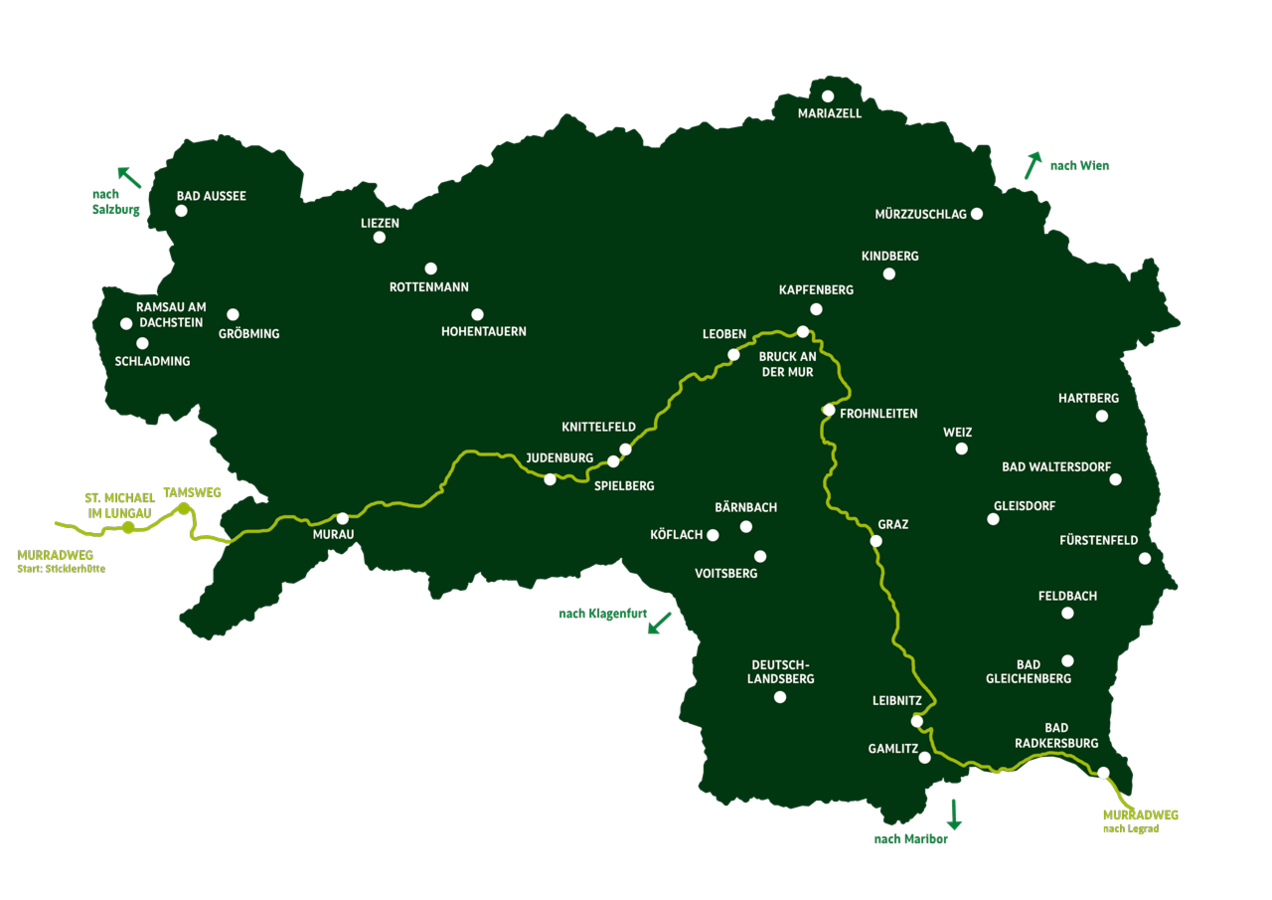
Interesting facts about the Mur Cycle Path
The Mur Cycle Path R2 is probably the most diverse river cycle path in the Alpine region. From its source in the Hohe Tauern National Park in the Salzburg region, it runs along the Mur River to the wine and spa region in the border triangle of Austria, Slovenia and Hungary. There are plenty of highlights along the way, such as the Graz adventure region with the Styrian capital, which is about halfway along the route. But there are also other places along the way that are definitely worth stopping off at. The best thing about it is that most of the sights don't even require a detour, as they are located directly on the route!
- Coming from the north, the skyline of the picturesque town of Frohnleiten catches the eye. The nearby Rabenstein Castle is also impossible to miss.
- At the Austrian Open-Air Museum in Stübing, you can take a leisurely and relaxed stroll through the whole of Austria.
- It is worth making a short detour from the Mur Cycle Path to the world's oldest surviving Cistercian monastery, Stift Rein. Apart from the baroque beauty of the basilica and the impressive monastery complex, a blessing from above for the rest of your journey can't hurt.
- Austria's largest stalactite cave, the Lurgrotte Peggau, is a unique natural wonder.
- In Austria's culinary capital of Graz, the medieval old town, a World Heritage Site, and futuristic architecture form a charming contrast. The Schlossberg, museums, theatres and many other highlights make Graz a popular stopover.
- Fancy a refreshing dip along the way? Schwarzlsee and Copacabana in the south, as well as other swimming pools and lakes along the route are ideal for this.
- Over 70 sculptures, perfectly integrated into the natural surroundings, can be experienced in the Austrian Sculpture Park. With free admission, it offers cultural enjoyment in the countryside during a walk or a relaxing picnic.
The Mur Cycle Path leads from the alpine north with mountains, alpine meadows and lakes to the south with the vineyards of southern Styria. Along the 453 varied kilometres of cycle path lies the city of Graz, which is simply a must-see.
The Tour de Mur is a cycling event on the Mur Cycle Path R2, which is held over 3 stages. In 2027, the Tour de Mur will take place from 27 to 29 May. Participants cover a total of 333 km from Lungau in Salzburg, across the whole of Styria to Bad Radkersburg. Graz is the stage destination every year.
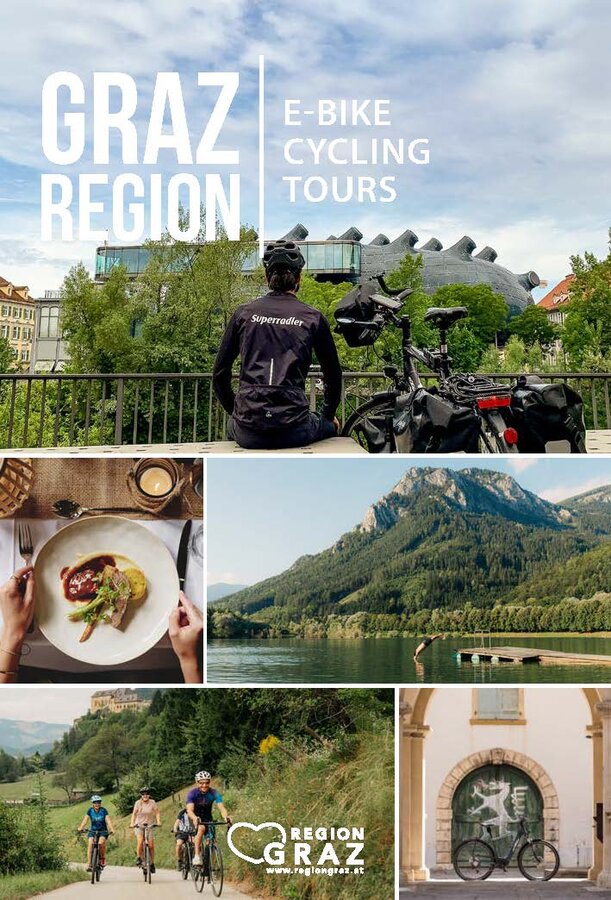
E-BIKE LEISURE CYCLING TOURS
For e-bikers and sporty touring cyclists
Along the left and right banks of the Mur are 18 rewarding e-bike leisure cycling tours that offer something for every fitness level: tours on the flat in the south, tours with lots of ascents and descents in the east and in the home of the
Lipizzaner horses, as well as challenging tours around the Schöckl.
Magnificent panoramas, scenic views of the mountains and nature, historical
cultural monuments, refreshing bathing lakes and, of course, regional delicacies and modern gourmet cuisine can be found along all the cycle routes.
Most of the tours take the cyclists along asphalt cycle paths and quiet country roads. A small part of the routes also go over unpaved cycle paths, gravel roads and country paths. The national roads are only used where there is no alternative or if there is a cycle lane.
The tours are suitable for e-bikes but also for touring bikes, trekking bikes and gravel bikes without electric support. Mountain bikes – provided that they are suitable for road traffic – are, of course, also suitable, but not necessary for these routes.
By the way: All routes, including details, elevation profiles and insider tips, can be found in the brochure "E-Bike Cycling Tours in the Graz Region" – download it now and discover new favourite places, or order it by post here!

Interesting facts about the Meridiem Trail
The Meridiem Trail is a long-distance cycle route from Vienna via Graz to Villach (with an optional extension to the Adriatic Sea). It connects nature, culture and enjoyment over approximately 580 km on existing cycle paths.
Graz is located on two central stages – the connection from Feldbach to Graz and the onward journey from Graz towards Wildon and Eibiswald.
Stages 5–6: After the Styrian volcanic region, the route leads from Feldbach via Gleisdorf to Graz. The route first takes you through rolling hills, past vineyards and on along the historic Roman road to Graz – ideal for a first longer break, exploring the old town or an urban stop in the culinary capital of Styria. A visit to the Schlossberg is a must!
Stages 6 - 7: From Graz, the trail continues its route through southern Styria: the Mur Cycle Path takes you to Wildon and along historic paths towards Eibiswald. This stage combines urban flair with rural landscapes and invites you to enjoy further experiences along the way.
The classic tour can be completed in 6 to 12 daily stages, depending on the daily mileage, choice of accommodation and individual breaks.
Yes – the Meridiem Trail has been designed to be easily accessible for both conventional bicycles and e-bikes. The trail largely uses existing cycle paths and rail connections and is ideal for e-bikes and conventional touring bikes – perfect for active holidaymakers, leisure cyclists and culture enthusiasts alike.
Graz is the starting point and halfway point for two stages of the Meridiem Trail. You can take a break here, explore the sights or continue your journey by train.
Graz, Austria's second largest city – and also the second largest on the Meridiem Trail – delights visitors with its distinctive blend of history, culture and Mediterranean lifestyle. As a UNESCO World Heritage Site, the city offers an impressive architectural diversity from many eras and, at the same time, a relaxed, southern atmosphere that invites you to linger.
No wonder Graz also bears the title ‘Austria's capital of delight’. South of the Alps, exceptional products are created here by innovative producers, which are then transformed into culinary masterpieces in the city's kitchens. Whether in an elegant restaurant, a rustic tavern or a shady beer garden – here you can enjoy Styrian cuisine at its finest.
Graz is also a university city. More than 60,000 students shape the cityscape and create a young, dynamic atmosphere. You can feel this in the numerous bars and restaurants, in the squares – and, of course, on the cycle paths, because cycling is simply part of life in Graz.
Length & duration: The entire route covers approx. 580 km and is typically completed in 6 to 12 daily stages – depending on how leisurely or athletic you want to be.
Signage & navigation: GPS tracks, navigation packs and detailed route data are available online. Accommodation and dining tips are also included. Find out more about navigation packs that are available for purchase here.
Transport & combination options: Thanks to the proximity to railway stations along the trail, e.g. in Graz, the return journey or stage planning can be flexibly combined.

Bike service points in Graz
If you have problems with your bike, drop by at the city’s bike service point and have your ride restored to working order.
Discover Graz by bike
A clever combination
You don’t have much time but want to see as much as possible? On two wheels, Graz can be explored at speed. For some inspiration, check out our ideas for seeing Graz in 24 and 48 hours respectively!


